Class: Reptilia Order: Squamata Family: Crotalidae Genus: Crotalus Species: horridus
Timber Rattlesnakes are a stout bodied, yet long venomous snake. Its adult length can range from 2.5 to 5 feet, with some reported being as long as 7 feet. It's generally black gray, light yellow, or greenish white with 20-25 black, jagged crossbars or blotches. Sometimes it may have an orange or rust stripe down midback. Its head is clearly larger than its slender neck, and it has a dark stripe behind each eye. In adults, the tip of the tail is uniformly black with a rattle or button. These animals are venomous but not especially aggressive; however, they will bite if bothered. Their bite is serious, though rarely fatal to humans.
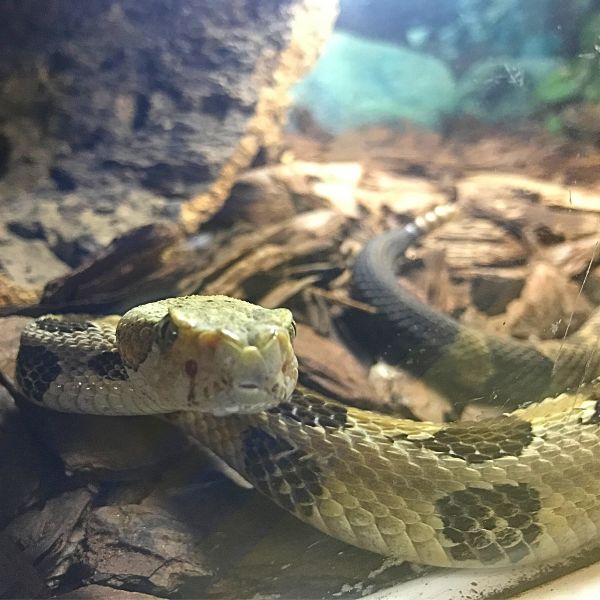
Timber Rattlesnakes prefer mature forests, or hilly areas, and rocky outcrops or ledges where they can find cover and suitable places to hibernate. In the winter, they often brumate communally in underground rock crevices.
In the wild, their diet would consist of mainly small mammals such as rodents like mice, squirrels and chipmunks, birds, frogs, and lizards. While in captivity their diet consists of rodents.
Help Feed Our Timber Rattlesnake
Predators of the young include hawks, coyotes, skunks, foxes, and common kingsnakes. Most adult mortality is caused by vehicles, wanton killing by humans, and clearing of forest.
Sometimes they are called the “banded,” “velvet-tail,” or “canebrake” rattler. They are the only rattlesnake in most of the Northeast, but they have been completely extirpated in many areas where they were once numerous.
Their status in Illinois is listed as threatened. They were previously more widespread, but now probably occur in moderate numbers only in the Shawnee Hills.