Class: Reptilia Order: Testudines Family: Emydidae Genus: Pseudemys Species: concinna
The Eastern River Cooter is a subspecies of the River Cooter which is primarily found in the eastern and central U.S. reaching from eastern Virginia through eastern Texas, extending northward to Ohio and south to northern Florida with scattered midwestern populations. Adults can reach up to 16.5 in in carapace or hard upper shell length; females are generally larger than males. The carapace is dark greenish brown with a characteristic backward-facing “C” marking bordered in yellow, while the plastron or underside of the shell is yellow to reddish orange with dark seams.
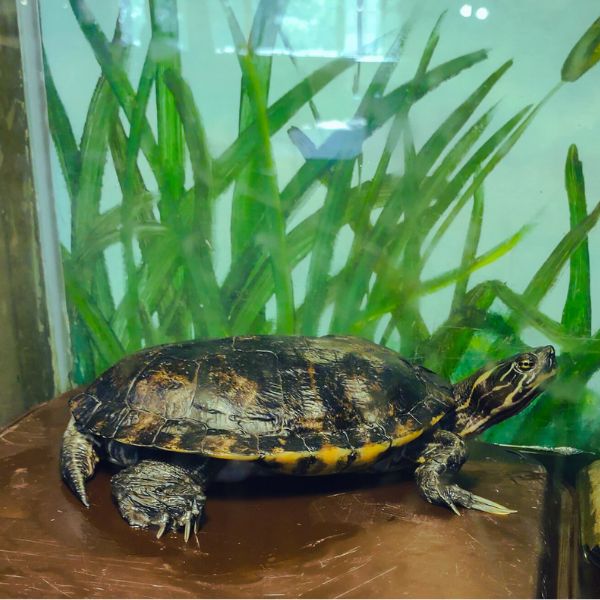
This turtle prefers permanent freshwater bodies like rivers, lakes, and ponds with abundant aquatic vegetation. They are typically found in shallow zones, though they may occupy deeper, clearer waters in larger groups. They utilize terrestrial areas like sunny logs or nesting grounds in the water.
In the wild adult’s diet are primarily herbivorous, consuming aquatic plants and algae which make up 95% of their consumption. Juveniles are more omnivorous, feeding on small invertebrates, crustaceans, and fish. In captivity, they will consume a combination of leafy green, aquatic vegetation, occasional proteins like insects, or small fish which will be supplemented with commercial turtle pellets.
Help Feed Our River Cooter
Eastern River Cooters have a fascinating adaptation that helps them stay underwater for long periods. Near their tail, they have a special structure called a cloacal bursae. This acts almost like a built-in snorkel system, allowing them to absorb oxygen directly from the water. Instead of coming up for air frequently, they can remain submerged for hours, especially in cold water where their metabolism slows down. This ability is incredibly useful during winter when they spend time at the bottom of rivers or lakes, conserving energy and avoiding predators.
Eastern River Cooters are usually solitary creatures, but they have a very social side when it comes to basking. On sunny days, you might see several of them gathered on the same log or rock, stacked like a living tower. This behavior isn’t just for fun. It’s essential for their health. Basking helps them regulate body temperature, absorb UV rays for shell and bone strength, and dry out to prevent fungal infections. Sometimes dozens of turtles will share a single spot, creating an impressive display of cooperation. These gatherings also provide safety in numbers, as a group is more alert to predators than a lone turtle.